


Our Historical O Level Performance


A Proven Methodology for High Distinction Rates
A Comprehensive Curriculum that covers all essential examinable components, including Listening Comprehension & Oral Examination, tailored to the latest MOE Syllabus.
Composition & Situational Writing

Through our proprietary writing curriculum, students are taught replicable techniques to craft original stories of their own—without relying on spoon-fed model essays. Using bite-sized writing exercises, curated content packs with stories and statistics for idea generation, and a strong focus on vocabulary development and creative expression, we equip students with the skills to handle any essay type they encounter in exams.
Situational writing, which carries equal weightage to composition writing, is also given significant attention. Students are trained to score confidently through our library of adaptable situational writing templates that can be applied across different question styles.
Over the course of the year, students can expect to complete more than 20 compositions and situational writing tasks, all of which are comprehensively marked with detailed feedback and guidance on how to improve.
Comprehension Skills & Summary Writing
We break comprehension down into clear question types and core skills, training students to recognise each question type and apply the appropriate techniques and answer structures to maximise their scores. Rather than relying on repetitive drilling, we focus on building proficiency and familiarity across a wide range of question styles, helping students develop a mental library of strategies that can be applied to both narrative and non-narrative comprehension passages.
Summary writing is often a challenge for many students due to the complexity of the task. We address this by teaching a simple two-step process to accurately identify key points, followed by a step-by-step approach to paraphrasing and removing redundant words.

Term Assessments & Differentiated Homework
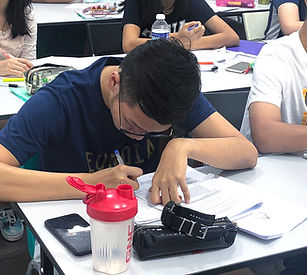
Students take a termly assessment covering all examinable components and receive a comprehensive report analysing their performance. Identified weaknesses are addressed through differentiated homework, with each student receiving tasks tailored to their specific needs. All homework is marked with detailed feedback provided, and additional practice is available upon request—there is no need for extra practice papers or assessment books.
Meet the Team

Teacher Naga
Ex Level Head of Pri/Sec English
Head of English at Hess Academy
13+ Years Experience

Teacher Alison
English Specialist, Head of IP English
20 + Years Experience
Ex-NYGHS
PDGE in English & Literature

Teacher Sruthi
English Specialist, Pri/Sec
2 + Years Experience
Graduated from RGS, RI
NUS (BA. Faculty of Arts & Social Sciences)
Stories of Growth and Success
Since 2016, we have a 100% improvement rate for students who join us for 6 months or more. Hear what parents and students have to say about English classes at Hess Academy.
Jayne Tan
My boy started O Level English lessons with Hess Academy only in Term 2. But with only this short period of time to O Levels exams, he improved 3 grades for his O Levels English! We would like to thank Teacher Alison for her dedication to her students! She's really awesome!
Tom Zhou
Ms. Alison Chee was an exceptional English tutor who transformed my IBDP experience. Her expertise and patience helped me raise my final IB grade by 2 points from my first-year predicted grade. She tailored her lessons to my needs, refined my writing skills, and boosted my confidence in analyzing a wide range of literary works. Despite my initial challenges with writing comparative essays, she provided clear guidance on analyzing complex texts and mastering literary techniques. I’m deeply grateful for her support and would highly recommend her and Hess Academy to anyone seeking exceptional guidance in English.
SL
Both my boys attend Hess. We are very impressed with the quality of the teaching and curriculum. The teachers (namely T. Terence and Alison) are not only well-versed and highly qualified, they are also responsive and are willing to work closely with parents, often at the expense of their personal time. I would also like to mention that administration is very efficient and supportive. We are grateful to have found Hess, and just wish we had found them earlier!
Ace Your Exams with these bite-sized Study Hacks / Exam Tips!
EXAM TIP
Don't Make This Mistake Your Personal Recount!
IN FOCUS
Tackling Comprehension: "In Your Own Words" Questions
IN FOCUS
The vital Element You Must Have In A Personal Recount Essay
IN FOCUS
The Core Element To a Solid Argumentative Essay
FAQs
Q: How is the O Level English curriculum structured?
Each lesson is exam-centric and builds mastery through targeted exercises. Classes focus on improving specific weak areas weekly, with structured frameworks, guided examples, and customised in-house notes designed by ex-MOE educators.
Q: What makes Hess Academy’s O Level English programme different?
We don’t mix O Level and IP classes — ensuring a focused and level-appropriate curriculum. Every lesson is interactive, anchored in current affairs, and supported by lesson recordings, free consultations, and WhatsApp access to tutors for instant feedback.
Q: How does Hess Academy help students improve writing for O Levels?
Students are trained to use a reliable writing framework that works across essay types. We teach structure, content development, and language precision through guided examples and step-by-step writing practice for both narrative and discursive essays.
Q: How are comprehension and paraphrasing skills taught?
We use proven analytical and paraphrasing methods that train students to identify key ideas and answer with precision. Students practice tackling different passage complexities with a clear approach that can be replicated in any exam scenario.
Q: What kind of materials do O Level students receive?
All resources are created in-house — including model essays, comprehension drills, summarised notes, and skill-based worksheets. These materials are structured for active retention and practical exam application.